When I was first married, back in the late '70s, we couldn't afford much, but we found a cheap apartment in Hollywood. Not the nice part of town but downtown. It was across the street from where a bunch of hookers lived (apparently they avoided our apartment building because you needed a key to get in the front door of the building). That apartment came furnished, which we needed, but it was also furnished with cockroaches. Lots of them. We used to go out to horror movies a lot, just to see depictions of someone whose life was worse than ours.
Six months later, when the lease was up, we hightailed it out of there for the suburbs, where we found a brand new house that had been built by the landlord, who also lived on the property. The lot was about half an acre, very deep and skinny, and it had a tiny old house on the front corner. The landlords had built themselves a big, narrow two-story house on the other front corner, and the garage was on the end of the house that was away from the street. Across the long driveway from the landlord's house, directly behind the tiny old house, the landlords had built two tiny new one-bedroom houses, and they rented out all three of the tiny houses, of which the middle one was ours. The way they designed their house, the landlords could (and did) come out of their master bedroom and onto the flat roof of the garage, where they could overlook their domain. As uncomfortable as it could be living in an outbuilding of a feudal manor, it was a million times better than living with cockroaches.
Now, we were still pretty broke, so we didn't have much in the way of furniture. Our decor was Early American Garage Sale combined with Stuff We Made Ourselves. Our living room couch during family gatherings was the back seat pulled out of our 1964 Mercedes 220Sb (the car was a wedding gift from one of my husband's college roommates - he had found the car abandoned in a field and got the Sheriff's title to it and rebuilt the engine for us). Our mattress was nothing more than a big piece of foam on the carpet.
Life was pretty good there. We liked our rental neighbors and tried not to interact much with our feudal lords.
One Saturday morning, probably about 7:00 (an ungodly hour for a Saturday), I opened my eyes a crack, because I'd heard a soft noise outside next to the house. Not far from where I was lying, I noticed a line of ants walking along the top of the baseboard. In my desire to get back to sleep, my mind calculated that the ants weren't approaching me, and so I decided I could tell my husband about it later, so I closed my eyes and slept some more.
The noise outside continued and must have become more forceful, because my husband suddenly sat straight up in bed and expressed his annoyance and determination to investigate. That's when I woke up, opened my eyes again, and saw that the line of ants had become a superhighway of at least four lanes that followed the baseboard, turned a corner, climbed up the wall to the 4-inch potted philodendron that rested on the windowsill, and climbed up the side of the pot and into the dirt. Horrified, I looked more closely: all those ants were carrying eggs.
My husband came back from his investigation. It seemed Mr. Lord of the Manor had taken it in his mind to do a bit of weeding right next to our house at the crack of dawn and had dug up an ant's nest with his shovel, and the newly homeless ants had decided to move lock, stock, and hatchery right into my philodendron. CREEPED. ME. OUT!!!
After much Raid and airing out of the room - and the Raided philodendron in the garbage can - we resumed life again. Because this is California, we've had ant invasions countless times in countless abodes, but they haven't brought their eggs with them. Most of the time they're looking for something to take home with them. They die for their efforts, of course, because this is me we're talking about.
Fast forward to last night. Friday night. A good night. My son came over with the new (to him) game he bought, used, at the game store, and we gave it a try. It's called, Hansa, based on the old Hanseatic League. My son won, and then he and my daughter played Carcassonne while I hit the treadmill, and then after my daughter won, my son went home. My daughter was pretty tired, so she went over to the power strip to unplug her laptop before going to bed. She let out a disgusted, "Mom, there's a million ants over here!"
When I got over there and peeked behind the shelves that hold all our TV-attached devices, the power strip had ants crawling all over it, and the narrow space between that and the wall was black with them. I didn't know if some sort of horrible vermin had died back there and attracted all of them, or what. It was repulsive. And it's been years since there's been a husband to call to come deal with it.
We moved the shelves out of the way, and then my daughter sprayed the heck out of them. They were coming in from under the bottom of the baseboard. This is what it looked like post-spraying, when they were all DEAD.
There was nothing they were trying to eat or take home. All those white things were their eggs. They had decided that making their new home under the warmth of the power strip was just the thing for a Friday night. I can't begin to say how many times and in how many ways we expressed our revulsion at what was happening in our very own home.
After inspecting the rest of the house and seeing no other incursions, we finally went to bed to give the bug spray a chance to dry before we tried vacuuming.
In the morning the real work began. We moved furniture for better access, vacuumed, swept, and wiped down all the wires with wet disinfecting wipes. As a last task, I wiped all the ants off the power strip - top, bottom, and sides - then set it down on the blue-ray player while I wiped off its power cord. I picked up the power strip to start putting everything back together when I noticed a bunch of white eggs on the top of the black player. Noooo!!!
Then I hit the power strip against the floor a couple times , and this happened:
Their new nest was INSIDE the power strip! That thing had to go. We got out a brand-new garbage bag for the power strip and vacuum cleaner bag (once the new pile of disgust was cleaned up), because you can't trust the plastic shopping bags you get at stores to be air- and ant egg-tight. Since my daughter needed to go to Walmart for some food, she volunteered to pick up a new power strip. This one is a wall-mount model, so there should be less opportunity for the ants to make their home inside it (at least, that's what we're telling ourselves).
All of our various pieces of electronic equipment are now plugged in, and we're back in business. We have no idea what gave the ants the idea that it was time to move - it's not as though our landlord was digging in the dirt beside the house - and I know better than to ask God what on earth He was thinking.
It says in the book of Revelation that God will wipe every tear from our eyes. I am confident that this memory, too, will be wiped away along with my tears when I get to heaven. It can't be the kind of thing we have to think about forever. Eternity without ants and their eggs is a very, very comforting thought.
Friday, October 28, 2016
Monday, May 30, 2016
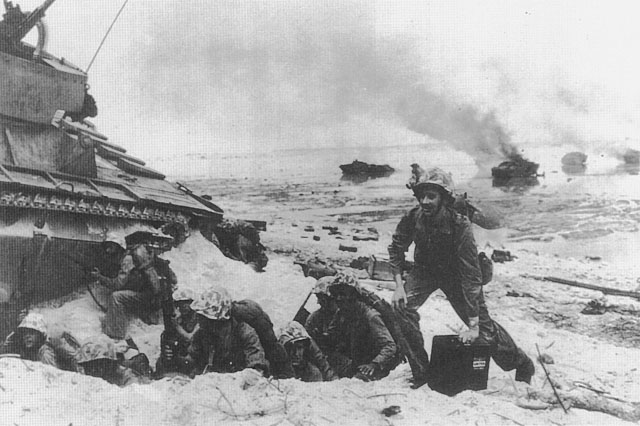
For Memorial Day
(Photo source: www.ibiblio.org/hyperwar/USMC/USMC-C-Peleliu/)
Instead, I've been catching up on some of my internet reading, those articles and opinion columns I've opened in separate tabs in the morning to read later when I have a few minutes to rub together. Normally, that means very late at night when I'm beyond sleepy, and I end up just scanning the columns and deciding that I don't want to take the time to read most of them after all. Sometimes I fall asleep sitting in front of the computer, and one time when I woke up from this, both of my hands were asleep from having dozed off with my face cupped in my hands.
So it's a treat to be able to read when I'm actually awake. Which brings me to today's reading...
The Library of Law and Liberty yesterday reprinted a Memorial Day column from 2013 by Richard Reinsch, called, With the Old Breed. It's Reinsch's take on Eugene Sledge’s book of the same name. Reinsch explains, "I’ve been reading With the Old Breed, Eugene Sledge’s classic account of his experiences in the battles of Peleliu and Okinawa. Many have come to know his story from the successful 2010 HBO Series The Pacific that relied in part on his diary of these two battles."
I've mentioned before that I don't have much family connection to World War II. My dad was too young to enlist, and his dad had fought in World War I. By WWII, he was stateside training the troops until after the war, when he was sent to Europe to do Graves Registration work for a couple years. Still, my heart seeks out stories that highlight America's greatness, and World War II was about the last time when that greatness shone brightly throughout our nation. Not only did good men—and good women as well—volunteer to fight against the wickedness and evil that threatened to take over the world, but on the home front, individuals, corporations, and even Hollywood and the news media supported our war efforts. Dissenters were relatively few and far between.
Not so now. And stories like the one told by Eugene Sledge only serve to highlight the changes that have occurred in America since then.
In his opening, Reinsch includes a quote from the book:
The narrative “Sledgehammer” provides is compelling, horrific, and
fascinating. A member of the famous 3rd Battalion, 5th Marines, he
describes the landing on Peleliu:
Huge geysers of water rose around the amtracs ahead of us as they approached the reef. The beach was now marked along its length by a continuous sheet of flame backed by a thick wall of smoke. It seemed as though a huge volcano had erupted from the sea, and rather than heading for an island, we were being drawn into the vortex of a flaming abyss. For many it was to be oblivion.
The accounts of the island battles are appalling. There is little
redeeming value, Sledge concludes, from these sojourns into hell. But the “Old
Breed” must abide, he says.
And
who are the Old Breed for Sledge? At one level, this was simply the nickname
given to the First Marine Division that had served in the earliest engagements
of the Pacific campaign at Guadalcanal and Cape Gloucester. That much is true.
Their lineage is great, stretching back to World War I. Sledge is proud
of being a part of this unit of men, and it comes blaring through the text. No
punches are pulled in his description of the fighting.
One more quote from Reinsch:
Sledge
is at turns bitter at his training officers in boot camp and in later
preparatory phases. Camp was humiliating and physically exhaustive. Failure at
a task led to a visit from the screaming instructor. You operated without
requisite sleep. However, in a footnote he criticizes those who now critique
the Marines for being too extreme, too inhumane in their training. Sledge knows
that in the mud of combat, the discipline and the supports such training gives
your will are all that a Marine possesses. It comforted him, he reports, that
the man in his foxhole, and in surrounding foxholes, had received the same
treatment.
That men endured—and continue to endure—such training and then willingly engage in overwhelmingly dangerous battle on our behalf is both humbling and impressive beyond measure. Those who paid the ultimate price deserve daily the remembrance and honor they receive each year on Memorial Day.
Monday, June 30, 2014
Reading The Little Prince
When I was in sixth grade, in San Diego, we were required to take Spanish. We learned the basics, like:
Hola, Paco. ¿Como estas?
Muy bien. ¿Y tu?
Estoy bien, gracias.
I was pretty good at it, but I resented having to learn it, so I was determined to hate Spanish.
At the end of that year, they handed out questionnaires to the students who got an 'A' in Spanish (yes, I liked getting A's, even if I had to speak Spanish to get them), asking us to choose a language preference for junior high for a new program they were starting. Instead of waiting until high school to teach languages, besides sixth-grade Spanish, they were going to start in seventh grade and needed to know how many kids wanted which languages. We were to rank in order our preference for Spanish, German, or French. I picked French first, German second, and Spanish last.
After all the votes were tallied, there wasn't enough interest for a German class, so the kids who picked German got their second choice. Everyone else got their first. We ended up with two Spanish classes and one French class, and I was thrilled not to have to take Spanish ever again.
In seventh grade, I learned the basics of French, like:
Bonjour, Guy. Ça va?
Pas mal. Et toi?
Ça va bien, merci.
Our teacher started us, the first two weeks, with nothing but memorization and repetition. We were not allowed to see written French until the third week, and when we did, it blew our minds. So many letters to say so little! Like the word for water, pronounced "oh," is spelled eau. It took a while, but eventually we got the hang of spelling and pronouncing.
I studied French all three years of junior high, and at the end of ninth grade, my dad retired from the Navy, and we moved to Montana where they didn't have the special program that started languages in seventh grade. So I took Senior (fourth-year) French when I was a sophomore and had to go my junior and senior years without it. Then I took a full year of it my first year of college. By the end of that year, I was mostly thinking in French and spoke it fairly fluently for someone who learned it in school.
Sometime during all that studying, though probably not in the first year, one of our teachers mentioned Le Petit Prince - The Little Prince - a classic children's book that I think we read in class. I loved it.
A long time later, after I was married and had little kids, I saw the book, in French, in the bookstore, and I bought it to refresh my skills. It was every bit as wonderful as I remembered. Even the French words seemed to make it more charming. In the first chapter the author talks about a book he read as a child, about the wildlife in the virgin forest. The phrase for wildlife is animaux sauvages, which is literally, "savage animals." I just love it!
In the evenings, I would sit both kids on my lap and "read" the book to them, translating from the French with only the occasional help from the French-English dictionary. I loved reading the story, and they loved hearing it.
Eventually, I found the book in English, and I bought that one too.
It made things easier when I needed help with my translations. I simply had to flip to the page with the fox picture to see that apprivoiser means "to tame."
Time went by, and the books got packed in boxes for all our various moves, only to be pulled out again whenever I came across them. I always went for the French version and read at least the first few chapters to make sure I still could. I hadn't realized how well-ingrained in my mind those chapters became.
Last week, in my nightly Bible reading, I finished reading it all the way through. After the close of Revelation, I went to my bookcase shelf with all my Bible-studying books, looking for a topical book to do before I start my next time through the Bible again. I selected one that has a workbook to go with it, and when I pulled the two books out, The Little Prince, in English, was tucked inside the cover of the workbook as though I hadn't paid attention when I had put it away. I'm not sure where the French one is.
I brought The Little Prince to work to show to one of the guys I had mentioned it to not too long ago, and I made it available to anyone in our group who might want some light reading at lunchtime, but there were no takers. So I picked it up to read over lunch myself.
It's not the same. It's in English.
I keep hearing the French in my head as I read it. The dedication page ends with, "To Leon Werth when he was a little boy," but I hear, "À Léon Werth, quand il était un petit garçon." In the first chapter, the picture book called "True Stories" is "Histoires Vécues." The boa constrictor is un serpent boa. And in the second chapter, the little prince demands over and over, "Dessine-moi un mouton."Finally, I put the book down. I couldn't read any further for all the French interruptions.
One of these days, I'm going to have to go hunting for that familiar, beloved white cover. And then I'll sit down in a cozy spot with a nice cup of hot tea and the blue-covered translation on the table beside me, and I'll start reading. And the characters and the drawings and the words - en français - will come to life for me once again.
Hola, Paco. ¿Como estas?
Muy bien. ¿Y tu?
Estoy bien, gracias.
I was pretty good at it, but I resented having to learn it, so I was determined to hate Spanish.
At the end of that year, they handed out questionnaires to the students who got an 'A' in Spanish (yes, I liked getting A's, even if I had to speak Spanish to get them), asking us to choose a language preference for junior high for a new program they were starting. Instead of waiting until high school to teach languages, besides sixth-grade Spanish, they were going to start in seventh grade and needed to know how many kids wanted which languages. We were to rank in order our preference for Spanish, German, or French. I picked French first, German second, and Spanish last.
After all the votes were tallied, there wasn't enough interest for a German class, so the kids who picked German got their second choice. Everyone else got their first. We ended up with two Spanish classes and one French class, and I was thrilled not to have to take Spanish ever again.
In seventh grade, I learned the basics of French, like:
Bonjour, Guy. Ça va?
Pas mal. Et toi?
Ça va bien, merci.
Our teacher started us, the first two weeks, with nothing but memorization and repetition. We were not allowed to see written French until the third week, and when we did, it blew our minds. So many letters to say so little! Like the word for water, pronounced "oh," is spelled eau. It took a while, but eventually we got the hang of spelling and pronouncing.
I studied French all three years of junior high, and at the end of ninth grade, my dad retired from the Navy, and we moved to Montana where they didn't have the special program that started languages in seventh grade. So I took Senior (fourth-year) French when I was a sophomore and had to go my junior and senior years without it. Then I took a full year of it my first year of college. By the end of that year, I was mostly thinking in French and spoke it fairly fluently for someone who learned it in school.
Sometime during all that studying, though probably not in the first year, one of our teachers mentioned Le Petit Prince - The Little Prince - a classic children's book that I think we read in class. I loved it.
A long time later, after I was married and had little kids, I saw the book, in French, in the bookstore, and I bought it to refresh my skills. It was every bit as wonderful as I remembered. Even the French words seemed to make it more charming. In the first chapter the author talks about a book he read as a child, about the wildlife in the virgin forest. The phrase for wildlife is animaux sauvages, which is literally, "savage animals." I just love it!
In the evenings, I would sit both kids on my lap and "read" the book to them, translating from the French with only the occasional help from the French-English dictionary. I loved reading the story, and they loved hearing it.
Eventually, I found the book in English, and I bought that one too.
It made things easier when I needed help with my translations. I simply had to flip to the page with the fox picture to see that apprivoiser means "to tame."
Time went by, and the books got packed in boxes for all our various moves, only to be pulled out again whenever I came across them. I always went for the French version and read at least the first few chapters to make sure I still could. I hadn't realized how well-ingrained in my mind those chapters became.
Last week, in my nightly Bible reading, I finished reading it all the way through. After the close of Revelation, I went to my bookcase shelf with all my Bible-studying books, looking for a topical book to do before I start my next time through the Bible again. I selected one that has a workbook to go with it, and when I pulled the two books out, The Little Prince, in English, was tucked inside the cover of the workbook as though I hadn't paid attention when I had put it away. I'm not sure where the French one is.
I brought The Little Prince to work to show to one of the guys I had mentioned it to not too long ago, and I made it available to anyone in our group who might want some light reading at lunchtime, but there were no takers. So I picked it up to read over lunch myself.
It's not the same. It's in English.
I keep hearing the French in my head as I read it. The dedication page ends with, "To Leon Werth when he was a little boy," but I hear, "À Léon Werth, quand il était un petit garçon." In the first chapter, the picture book called "True Stories" is "Histoires Vécues." The boa constrictor is un serpent boa. And in the second chapter, the little prince demands over and over, "Dessine-moi un mouton."Finally, I put the book down. I couldn't read any further for all the French interruptions.
One of these days, I'm going to have to go hunting for that familiar, beloved white cover. And then I'll sit down in a cozy spot with a nice cup of hot tea and the blue-covered translation on the table beside me, and I'll start reading. And the characters and the drawings and the words - en français - will come to life for me once again.
Saturday, March 29, 2014
What's That Word?
There's gotta be a term for when you go to YouTube (or the internet) and start watching videos (or reading articles), and there's another related video (or article) that catches your eye. So you click on that one, and then another one, and another, until you've gone from the political to the heartwarming to learning how to make fire from a 2-liter bottle of soda, and you look at the clock and see that two or three hours have passed without your having accomplished anything.
But I don't know what that word is. Or even if there is one.
But anyway, I did it again today.
It started when I was checking my twitter feed. Somebody had a link to Brit Hume describing the motivations of the Tea Party, which he nailed. Then when I tried to reply to one of the comments, YouTube made me log in, which put me at the YouTube Home page, where there were a bunch of "Recommended" videos, along with the merely "Popular" ones.
They recommended a video of a dog whose military owner came home from deployment, and that led to a brother surprising his sister at her graduation, and then the Ellen Show where a military family got to Skype with Dad, who was still deployed. After that one, I found a British reunion of a Royal Navy dad and his daughter, right after his daughter got finished singing before the Queen. I love the way the girl runs to her father. And then Toby Keith had a reunion on stage for a military wife and her returning husband. Those reunion videos always make me cry.
I didn't want to keep getting up for Kleenex (no, I wasn't smart enough to bring the Kleenex box to my desk), so I moved on to other things.
This one, on the material properties of fire ants in large quantities, was fascinating and creepy at the same time. I'm not sure why this was in the Recommended list for me, unless it was because a few months ago I spent part of a Saturday doing this same endless rabbit trail through YouTube but with science-y, survival-type videos.
On the Popular list, today anyway, is this short video of why relativity isn't always relative, or something. I'm a little surprised whenever I see science stuff listed as popular, because most people don't admit to liking science.
And then I noticed for the first time (yes, I realize everybody else in the world who is internet savvy knew this years ago) that I have a YouTube Playlist, which is all the videos I've "Liked." Most of them are songs, so then I had to find some more songs because some of my newer favorites weren't there. Like Big Daddy Weave's Redeemed and The Only Name (Yours Will Be), The Afters' Broken Hallelujah, and Hillsong United's Oceans. And I just now noticed that I need to add Mandisa's Overcomer.
So that's been much of my day, and I still don't have any term for the YouTube (or internet) wanderings, beyond "rabbit trail." I guess I'll have to go with that one for now, unless you've got a better one.
But I don't know what that word is. Or even if there is one.
But anyway, I did it again today.
It started when I was checking my twitter feed. Somebody had a link to Brit Hume describing the motivations of the Tea Party, which he nailed. Then when I tried to reply to one of the comments, YouTube made me log in, which put me at the YouTube Home page, where there were a bunch of "Recommended" videos, along with the merely "Popular" ones.
They recommended a video of a dog whose military owner came home from deployment, and that led to a brother surprising his sister at her graduation, and then the Ellen Show where a military family got to Skype with Dad, who was still deployed. After that one, I found a British reunion of a Royal Navy dad and his daughter, right after his daughter got finished singing before the Queen. I love the way the girl runs to her father. And then Toby Keith had a reunion on stage for a military wife and her returning husband. Those reunion videos always make me cry.
I didn't want to keep getting up for Kleenex (no, I wasn't smart enough to bring the Kleenex box to my desk), so I moved on to other things.
This one, on the material properties of fire ants in large quantities, was fascinating and creepy at the same time. I'm not sure why this was in the Recommended list for me, unless it was because a few months ago I spent part of a Saturday doing this same endless rabbit trail through YouTube but with science-y, survival-type videos.
On the Popular list, today anyway, is this short video of why relativity isn't always relative, or something. I'm a little surprised whenever I see science stuff listed as popular, because most people don't admit to liking science.
And then I noticed for the first time (yes, I realize everybody else in the world who is internet savvy knew this years ago) that I have a YouTube Playlist, which is all the videos I've "Liked." Most of them are songs, so then I had to find some more songs because some of my newer favorites weren't there. Like Big Daddy Weave's Redeemed and The Only Name (Yours Will Be), The Afters' Broken Hallelujah, and Hillsong United's Oceans. And I just now noticed that I need to add Mandisa's Overcomer.
So that's been much of my day, and I still don't have any term for the YouTube (or internet) wanderings, beyond "rabbit trail." I guess I'll have to go with that one for now, unless you've got a better one.
Earthquake!
California was struck by a 5.1 magnitude earthquake last night a little after 9:00 pm. The epicenter was in La Habra.
Twitchy has a round-up of photos of the damage around Los Angeles, and my favorite is this one.
I live in Oceanside (It's at the bottom of the map at the USGS link, above), about 100 miles away from the epicenter as the crow flies. At the time of the earthquake, I was at my desk unwinding with some mindless computer games, and I felt an odd sensation of movement without actually moving.
My desk chair wasn't rolling. None of my stuff was moving. The blinds weren't swaying. So I told myself it was probably just some unconscious muscle twitching in my leg making the chair feel as though it was making the slightest of motions.
About a half hour later, I checked my Twitter feed and saw tweets about an earthquake. Aha! I hadn't imagined it after all. The preliminary reports had it as 5.4, but by this morning it was classified as 5.1.
After last night's confusion followed by my incorrect conclusion, I decided it was time to get an earthquake detector at home. I've used them at work for years.
I don't go in for anything elaborate, though that's certainly an option. This lady developed an earthquake detector that uses actual electronics and complicated hardware that requires soldering and other things that seem to be beyond me, or at least beyond my desire to attempt it. And this store in Port Townsend, Washington, sells an earthquake detector that draws in sand. Here's what it looks like (the sand tracing is after an earthquake in Olympia, Washington in 2001):
The physics behind this type of detector is similar to a Foucault Pendulum, which is used to demonstrate the rotation of the earth. But while the Foucault Pendulum swings, an earthquake detector works by not swinging. If there's not an earthquake, the ground is still, and so is the pendulum. When an earthquake hits, the table that the pendulum holder is resting on moves with the earth, but the pendulum bob remains stationary in spatial terms. To our eyes, however, because we're also moving with the earth, the pendulum bob appears to sway.
Back in the late 1980's I worked in Irvine, close to Newport Beach. The building I worked in was huge, and my group's cubicles were out in the middle of the floor away from the stability of the walls. When heavy people walked by, or when people wheeled heavily laden carts down the nearby aisles, the floor would bounce and make us wonder if it was an earthquake. So I installed my first earthquake detector on my desk, looping the pocket clip of a hot pink highlighter over a rubber band and taping the top of the rubber band to the underside of my desk's overhead cabinet. Then, whenever we felt the floor moving, we'd check the detector. If it wasn't swaying, that told us the floor was moving up and down to somebody's footsteps or cart. But if it swayed, we were having an earthquake. This came in handy after the April 7, 1989, Newport Beach earthquake (we didn't need the detector for the actual quake, because pieces of the ceiling tiles were falling, and besides I was under the desk). The aftershocks were much smaller, and my detector was put to good use.
Well, now I'm ready for the next earthquake that happens while I'm at home. I've got my detector installed in a corner of my desk, and it's stopped swaying after the initial installation. Here is what will keep me from doubting my senses when an earthquake hits somewhere far enough away from here:
It's simple enough that anyone can make one.
Twitchy has a round-up of photos of the damage around Los Angeles, and my favorite is this one.
Photo source: https://twitter.com/opsays/status/449871256712925185
I live in Oceanside (It's at the bottom of the map at the USGS link, above), about 100 miles away from the epicenter as the crow flies. At the time of the earthquake, I was at my desk unwinding with some mindless computer games, and I felt an odd sensation of movement without actually moving.
My desk chair wasn't rolling. None of my stuff was moving. The blinds weren't swaying. So I told myself it was probably just some unconscious muscle twitching in my leg making the chair feel as though it was making the slightest of motions.
About a half hour later, I checked my Twitter feed and saw tweets about an earthquake. Aha! I hadn't imagined it after all. The preliminary reports had it as 5.4, but by this morning it was classified as 5.1.
After last night's confusion followed by my incorrect conclusion, I decided it was time to get an earthquake detector at home. I've used them at work for years.
I don't go in for anything elaborate, though that's certainly an option. This lady developed an earthquake detector that uses actual electronics and complicated hardware that requires soldering and other things that seem to be beyond me, or at least beyond my desire to attempt it. And this store in Port Townsend, Washington, sells an earthquake detector that draws in sand. Here's what it looks like (the sand tracing is after an earthquake in Olympia, Washington in 2001):
Photo source: http://i.imgur.com/y8Nya.jpg
The physics behind this type of detector is similar to a Foucault Pendulum, which is used to demonstrate the rotation of the earth. But while the Foucault Pendulum swings, an earthquake detector works by not swinging. If there's not an earthquake, the ground is still, and so is the pendulum. When an earthquake hits, the table that the pendulum holder is resting on moves with the earth, but the pendulum bob remains stationary in spatial terms. To our eyes, however, because we're also moving with the earth, the pendulum bob appears to sway.
Back in the late 1980's I worked in Irvine, close to Newport Beach. The building I worked in was huge, and my group's cubicles were out in the middle of the floor away from the stability of the walls. When heavy people walked by, or when people wheeled heavily laden carts down the nearby aisles, the floor would bounce and make us wonder if it was an earthquake. So I installed my first earthquake detector on my desk, looping the pocket clip of a hot pink highlighter over a rubber band and taping the top of the rubber band to the underside of my desk's overhead cabinet. Then, whenever we felt the floor moving, we'd check the detector. If it wasn't swaying, that told us the floor was moving up and down to somebody's footsteps or cart. But if it swayed, we were having an earthquake. This came in handy after the April 7, 1989, Newport Beach earthquake (we didn't need the detector for the actual quake, because pieces of the ceiling tiles were falling, and besides I was under the desk). The aftershocks were much smaller, and my detector was put to good use.
Well, now I'm ready for the next earthquake that happens while I'm at home. I've got my detector installed in a corner of my desk, and it's stopped swaying after the initial installation. Here is what will keep me from doubting my senses when an earthquake hits somewhere far enough away from here:
It's simple enough that anyone can make one.
Thursday, October 24, 2013
Unidentified War Dead
This hits a little closer to home for me than most WWII stories, but not because I have any family members like these.
The Chicago Tribune reported Sunday on the continuing failure of the U.S. government to identify the remains recovered from the battle of Tarawa 70 years ago. The article opens this way:
In September 1943, Tech. Sgt. Harry Arnold Carlsen wrote a letter to his mother and ailing father in suburban Chicago. The Marine told his parents he wouldn't be home for Christmas but was hopeful he'd visit them the next year.
"I would like to see you and dad once more," he wrote.
Carlsen still hasn't made it home.
About two months after writing to his parents for the final time, the 31-year-old died in a battle with Japanese forces on a Pacific atoll called Tarawa, part of the present-day nation of Kiribati. In west suburban Brookfield, where Carlsen grew up, the news arrived in a grim telegram sent two days before Christmas.
Carlsen is among tens of thousands of Americans who fought in World War II whose remains have never been identified. At Tarawa alone, where more than 1,100 U.S. troops died, upward of 500 service members were never found. Another 90 or so sets of remains still haven't been identified.
But a historian who once worked for the Department of Defense said Carlsen is a "most likely" match for a body cataloged decades ago as "Schofield Mausoleum No. 1: X-82" and buried as an unknown in a Hawaii military cemetery.
"I'd bet my house, your house and every house down the block that it is Tech. Sgt. Carlsen," said the historian, Rick Stone, a former chief of police in Wichita, Kan.
Carlsen's grand-nephew, Ed Spellman, has pushed without success to have the government exhume X-82's grave and test the DNA against a sample submitted by the Marine's family. He has been discouraged as bureaucrat after bureaucrat politely noted his request without seeming to act on it.
My dad didn't serve in World War II. He turned 15 about halfway between VE Day and VJ Day. His dad, though, was career Army. Born (as far as the Army knew) in 1900, Grandpa was a Major in his 40s by the end of WWII, and he spent the war stateside, training troops.
After the war, Grandpa was assigned to Graves Registration in France, and he was able to bring the family with him. From 1946 to 1948, they lived in three different cities: Paris, Fontainebleau, and Strasbourg. My dad was free to explore on his own much of the time, while Grandpa worked at identifying the remains of our war dead so their families could get the closure Tech. Sgt. Carlsen's family has yet to be given.
When the remains in the Tomb of the Unknown from the Vietnam War were identified in 1998, then-Secretary of Defense William S. Cohen announced at the opening of the grave, "We disturb this hallowed ground with profound reluctance, and we take this step only because of our abiding commitment to account for every warrior who fought and died to preserve the freedoms we cherish."
Apparently, that abiding commitment doesn't yet extend to the thousands of World War II dead who have not been identified. My grandfather would be ashamed.
The Chicago Tribune reported Sunday on the continuing failure of the U.S. government to identify the remains recovered from the battle of Tarawa 70 years ago. The article opens this way:
In September 1943, Tech. Sgt. Harry Arnold Carlsen wrote a letter to his mother and ailing father in suburban Chicago. The Marine told his parents he wouldn't be home for Christmas but was hopeful he'd visit them the next year.
"I would like to see you and dad once more," he wrote.
Carlsen still hasn't made it home.
About two months after writing to his parents for the final time, the 31-year-old died in a battle with Japanese forces on a Pacific atoll called Tarawa, part of the present-day nation of Kiribati. In west suburban Brookfield, where Carlsen grew up, the news arrived in a grim telegram sent two days before Christmas.
Carlsen is among tens of thousands of Americans who fought in World War II whose remains have never been identified. At Tarawa alone, where more than 1,100 U.S. troops died, upward of 500 service members were never found. Another 90 or so sets of remains still haven't been identified.
But a historian who once worked for the Department of Defense said Carlsen is a "most likely" match for a body cataloged decades ago as "Schofield Mausoleum No. 1: X-82" and buried as an unknown in a Hawaii military cemetery.
"I'd bet my house, your house and every house down the block that it is Tech. Sgt. Carlsen," said the historian, Rick Stone, a former chief of police in Wichita, Kan.
Carlsen's grand-nephew, Ed Spellman, has pushed without success to have the government exhume X-82's grave and test the DNA against a sample submitted by the Marine's family. He has been discouraged as bureaucrat after bureaucrat politely noted his request without seeming to act on it.
My dad didn't serve in World War II. He turned 15 about halfway between VE Day and VJ Day. His dad, though, was career Army. Born (as far as the Army knew) in 1900, Grandpa was a Major in his 40s by the end of WWII, and he spent the war stateside, training troops.
After the war, Grandpa was assigned to Graves Registration in France, and he was able to bring the family with him. From 1946 to 1948, they lived in three different cities: Paris, Fontainebleau, and Strasbourg. My dad was free to explore on his own much of the time, while Grandpa worked at identifying the remains of our war dead so their families could get the closure Tech. Sgt. Carlsen's family has yet to be given.
When the remains in the Tomb of the Unknown from the Vietnam War were identified in 1998, then-Secretary of Defense William S. Cohen announced at the opening of the grave, "We disturb this hallowed ground with profound reluctance, and we take this step only because of our abiding commitment to account for every warrior who fought and died to preserve the freedoms we cherish."
Apparently, that abiding commitment doesn't yet extend to the thousands of World War II dead who have not been identified. My grandfather would be ashamed.
Tuesday, October 15, 2013
A Message to All Women (and All Men)
A friend tagged me on Facebook for this video. Made me cry...
There's another one for men:
It's interesting that the comments on the women's video are overwhelmingly positive, with many saying they listen to this every day (sometimes multiple times a day). But the comments on the men's video are largely negative, with a lot of the negative comments being from Christian men who see the affirming statements as being too self-focused and therefore satanic in origin. It makes me wonder if those men don't have an ache to be loved, or if maybe their strongest ache is to be right.
I'm with the women (surprise!). God didn't make me so I could spend my time beating myself up. No, we're not to think more highly of ourselves than we ought to, but at the same time I don't believe we should think less of ourselves either.
God Almighty, the Creator of the universe, loves me so much that He thought I was worth dying for so He could have a relationship with me. He loves you that much too. These videos remind us that, though we see our flaws and doubts and sins written large in our lives, because of the saving blood of Jesus covering our sins, God sees past them to the beauty and strength (and all the rest) that He gave us when were fearfully and wonderfully made.
I'll be watching the women's video quite a bit, because I still need it.
There's another one for men:
It's interesting that the comments on the women's video are overwhelmingly positive, with many saying they listen to this every day (sometimes multiple times a day). But the comments on the men's video are largely negative, with a lot of the negative comments being from Christian men who see the affirming statements as being too self-focused and therefore satanic in origin. It makes me wonder if those men don't have an ache to be loved, or if maybe their strongest ache is to be right.
I'm with the women (surprise!). God didn't make me so I could spend my time beating myself up. No, we're not to think more highly of ourselves than we ought to, but at the same time I don't believe we should think less of ourselves either.
God Almighty, the Creator of the universe, loves me so much that He thought I was worth dying for so He could have a relationship with me. He loves you that much too. These videos remind us that, though we see our flaws and doubts and sins written large in our lives, because of the saving blood of Jesus covering our sins, God sees past them to the beauty and strength (and all the rest) that He gave us when were fearfully and wonderfully made.
I'll be watching the women's video quite a bit, because I still need it.
Monday, October 07, 2013
Conversion Decision Part 3
It's a given that I need to get a lot of my slides scanned, but what about the photos? In the back of my three-ring binder with the slides in sleeves are some black-and-white photos. The snapshot-sized photos have sleeves of their own, and three 8 x 10 prints are loose. None of either size are dated or labeled.
As near as I can tell, all the snapshots were taken sometime between mid-1981 and early 1984, but I'm leaning toward the '81 - '82 timeframe. The pictures were all developed together, with rounded corners. There are half a dozen photos of the white-water canoeing trip we (my then-husband and I, and possibly his youngest sister) took up to the Kern River when we were taking some safety-oriented canoeing classes through, I think, the Red Cross. That puts us in California, either pre-mid-1978 or post-July 1981. Between those dates, we were in Spokane, Washington.
The other photos from that roll of film include two shots of our cat, Quackenbush. We acquired him and his best-buddy, Wickersham, when they were teeny-tiny kittens in Spokane. So the pictures had to be after we returned to California in 1981.
There's a picture of me when I was 24 or 25:
There's a picture of my husband and another of him and his sister talking, but I haven't asked for their permission to publish those photos. Quackenbush doesn't care if I post his picture:
He wasn't a very smart cat, so he had to get by on his looks, which he did just fine. See how he's wearing his flea collar? It worked great in Spokane, where the fleas die down during the winter. In California, though, which has year-round flea season, the collar didn't do anything. And nobody had invented Advantage or its like at that time. And the fleas liked me better than they liked the cats. Aaarrrrgggghhh!!!!
OK. Enough whining.
The 8 x 10 photos were from the photography class I took when we were still new to Spokane. This is the class that first taught me about the Rule of Thirds. Part of the class was working in the darkroom to develop film and make prints. We only used B&W for the darkroom portion of the class. When it was time to use color film, our instructor had us use slide film. We had an assignment to choose a tree, any tree, and take a whole role of slide film of that tree from different angles and times of day. The second assignment was to take a whole role of slides of one person, and of course I picked my husband for that. We had to include at least one double-exposure shot.
One of the requirements of the photography class was that we had to have a 35mm camera. All I had was the Kodak Instamatic I got for my birthday one year in late grade school. It took the 126 cartridges. But my husband had an old Argus C3 manual camera that used 35mm film, and you had to use a separate light meter and then set the aperture and shutter speed accordingly. That's the camera I used for class, and the instructor kept telling the other students (who all had SLR cameras), "If she can do this with that C3, you should be able to do it too!"
Here are the three 8 x 10 shots that I developed. First is Wickersham:
He's the smart one. The white patch on his chest extended all the way up to his chin, and he had a good-sized black dot in the white just behind the jawline. Whenever he slept with his head upside-down, the black dot would show. Very cute!
This is an old concrete bridge over the river in Riverfront Park:
I had hoped it would be more contrasty for the black-and-white film, but it wasn't.
This was one of my night shots, also in Riverfront Park:
I had thought that since I have the printer/copier/scanner, I could scan the photos myself and just concentrate on sending slides to the scanning company. But after I scanned all these photos, I checked the properties on the files, and they were all scanned at 200 dpi. ScanDiego will scan them at 4000 dpi. So I'm going to have to factor into my decision-making any photos I might want to blow up and frame.
As near as I can tell, all the snapshots were taken sometime between mid-1981 and early 1984, but I'm leaning toward the '81 - '82 timeframe. The pictures were all developed together, with rounded corners. There are half a dozen photos of the white-water canoeing trip we (my then-husband and I, and possibly his youngest sister) took up to the Kern River when we were taking some safety-oriented canoeing classes through, I think, the Red Cross. That puts us in California, either pre-mid-1978 or post-July 1981. Between those dates, we were in Spokane, Washington.
The other photos from that roll of film include two shots of our cat, Quackenbush. We acquired him and his best-buddy, Wickersham, when they were teeny-tiny kittens in Spokane. So the pictures had to be after we returned to California in 1981.
There's a picture of me when I was 24 or 25:
There's a picture of my husband and another of him and his sister talking, but I haven't asked for their permission to publish those photos. Quackenbush doesn't care if I post his picture:
He wasn't a very smart cat, so he had to get by on his looks, which he did just fine. See how he's wearing his flea collar? It worked great in Spokane, where the fleas die down during the winter. In California, though, which has year-round flea season, the collar didn't do anything. And nobody had invented Advantage or its like at that time. And the fleas liked me better than they liked the cats. Aaarrrrgggghhh!!!!
OK. Enough whining.
The 8 x 10 photos were from the photography class I took when we were still new to Spokane. This is the class that first taught me about the Rule of Thirds. Part of the class was working in the darkroom to develop film and make prints. We only used B&W for the darkroom portion of the class. When it was time to use color film, our instructor had us use slide film. We had an assignment to choose a tree, any tree, and take a whole role of slide film of that tree from different angles and times of day. The second assignment was to take a whole role of slides of one person, and of course I picked my husband for that. We had to include at least one double-exposure shot.
One of the requirements of the photography class was that we had to have a 35mm camera. All I had was the Kodak Instamatic I got for my birthday one year in late grade school. It took the 126 cartridges. But my husband had an old Argus C3 manual camera that used 35mm film, and you had to use a separate light meter and then set the aperture and shutter speed accordingly. That's the camera I used for class, and the instructor kept telling the other students (who all had SLR cameras), "If she can do this with that C3, you should be able to do it too!"
Here are the three 8 x 10 shots that I developed. First is Wickersham:
He's the smart one. The white patch on his chest extended all the way up to his chin, and he had a good-sized black dot in the white just behind the jawline. Whenever he slept with his head upside-down, the black dot would show. Very cute!
This is an old concrete bridge over the river in Riverfront Park:
I had hoped it would be more contrasty for the black-and-white film, but it wasn't.
This was one of my night shots, also in Riverfront Park:
I had thought that since I have the printer/copier/scanner, I could scan the photos myself and just concentrate on sending slides to the scanning company. But after I scanned all these photos, I checked the properties on the files, and they were all scanned at 200 dpi. ScanDiego will scan them at 4000 dpi. So I'm going to have to factor into my decision-making any photos I might want to blow up and frame.
Sunday, October 06, 2013
Conversion Decisions Part 2
The first step in getting my slides converted into digital format was to find the darned things. I went to the shed and looked at every one of the boxes in there. At times like this, I'm thrilled that I'm organized just enough to use a Magic Marker on the side and end of every box to record the box's contents. My slides were not in there.
In the garage, where all my boxes of books that I can't fit in my house are stacked in three six-high stacks and all the other boxes that didn't fit in the shed are piled, I hunted some more and finally found the box marked, "Photos/Slides Japanese Plates.' Inside the box was all of this:
Perfect!
Out of respect for my back (that's a different story), I waited for my daughter to come home and bring the box in the house.
Back when we were taking our pictures as slides, we had a Bell & Howell slide cube projector, not a Carousel projector like everyone else, and the brown fake-wood-looking box had the cubes with all the slides from our big bicycle trip through Europe in 1983, plus a few cubes with slides from other trips.
I was able to make a good light box by using my computer and opening my Nook application to a book with two nearly blank pages together. By holding the slides up to the monitor, it was easy to see what they were.
After looking through all those cubed-up slides (which I had labeled with the date, location, and subject), I pulled out the photo album to the left of the fake-wood box. I opened it up, and it looked like this inside:
Ick! I'm SO glad there were no photos inside the "magnetic" pages. There was just one loose black-and-white photo, complete with photo-album-induced discoloration:
I remember making this little guy but not where or when it happened, though I have this vague sense that it might have been at Mt. Palomar and that it was before we had kids. It was a week when it had snowed in the mountains, with a pretty low-elevation snow line, so that weekend we drove up to the mountains to play in the snow. Of course, by then almost all of the snow had melted. We found one turnout on the north side of the mountain where there was still a patch of slushy snow, so that's where we stopped. We were barely able to form three regular-sized snowballs, and we stacked them on top of each other, set them on the asphalt curb, and found some acorn tops and twigs to give him personality. He's a charmer, isn't he?
After throwing the photo album in the trash, I turned to the blue binder full of slide sleeves. There were more slides from the Europe trip (all properly labeled), plus the Grand Canyon trip with the youngest sister-in-law before she got married, several shots of my nephew (who just turned 34) when he was 22 months old and I visited my sister and her then-small family in the Panhandle of Texas, and photos from the hot-air and helium balloon festival of 1981. I even have pictures of when the Greenpeace balloon got away from its handlers before it was completely filled with hot air, and it ascended (but not enough) and the basket hit the roof of some grandstands, tipping out the guy inside the basket, who was injured. The story made the local TV news that night, but I wasn't able to find a link to it for this post. Apparently 1981 was a very long time before the internet came on the scene. Anyway, I really love a lot of the balloon pictures.
The problem with most of the slides in the sleeves is that, other than the bicycle trip photos, the slides aren't labeled. I had put stick-on labels on the sleeves themselves for the first picture in a series, for example, "Grand Canyon 1st Day 11/81." I'm afraid to choose 500 of my favorites, send them in, and then get them back and not know what they are from. So my decision-making process has just become a bigger production than it already was. I found some clear return-address labels (1/2" x 1-3/4") in my supplies, and I'm printing two slide labels on each, at 6.5 pt. font, and cutting them in half lengthwise.
It's going to be a while before I get this done.
In the garage, where all my boxes of books that I can't fit in my house are stacked in three six-high stacks and all the other boxes that didn't fit in the shed are piled, I hunted some more and finally found the box marked, "Photos/Slides Japanese Plates.' Inside the box was all of this:
Perfect!
Out of respect for my back (that's a different story), I waited for my daughter to come home and bring the box in the house.
Back when we were taking our pictures as slides, we had a Bell & Howell slide cube projector, not a Carousel projector like everyone else, and the brown fake-wood-looking box had the cubes with all the slides from our big bicycle trip through Europe in 1983, plus a few cubes with slides from other trips.
I was able to make a good light box by using my computer and opening my Nook application to a book with two nearly blank pages together. By holding the slides up to the monitor, it was easy to see what they were.
After looking through all those cubed-up slides (which I had labeled with the date, location, and subject), I pulled out the photo album to the left of the fake-wood box. I opened it up, and it looked like this inside:
Ick! I'm SO glad there were no photos inside the "magnetic" pages. There was just one loose black-and-white photo, complete with photo-album-induced discoloration:
I remember making this little guy but not where or when it happened, though I have this vague sense that it might have been at Mt. Palomar and that it was before we had kids. It was a week when it had snowed in the mountains, with a pretty low-elevation snow line, so that weekend we drove up to the mountains to play in the snow. Of course, by then almost all of the snow had melted. We found one turnout on the north side of the mountain where there was still a patch of slushy snow, so that's where we stopped. We were barely able to form three regular-sized snowballs, and we stacked them on top of each other, set them on the asphalt curb, and found some acorn tops and twigs to give him personality. He's a charmer, isn't he?
After throwing the photo album in the trash, I turned to the blue binder full of slide sleeves. There were more slides from the Europe trip (all properly labeled), plus the Grand Canyon trip with the youngest sister-in-law before she got married, several shots of my nephew (who just turned 34) when he was 22 months old and I visited my sister and her then-small family in the Panhandle of Texas, and photos from the hot-air and helium balloon festival of 1981. I even have pictures of when the Greenpeace balloon got away from its handlers before it was completely filled with hot air, and it ascended (but not enough) and the basket hit the roof of some grandstands, tipping out the guy inside the basket, who was injured. The story made the local TV news that night, but I wasn't able to find a link to it for this post. Apparently 1981 was a very long time before the internet came on the scene. Anyway, I really love a lot of the balloon pictures.
The problem with most of the slides in the sleeves is that, other than the bicycle trip photos, the slides aren't labeled. I had put stick-on labels on the sleeves themselves for the first picture in a series, for example, "Grand Canyon 1st Day 11/81." I'm afraid to choose 500 of my favorites, send them in, and then get them back and not know what they are from. So my decision-making process has just become a bigger production than it already was. I found some clear return-address labels (1/2" x 1-3/4") in my supplies, and I'm printing two slide labels on each, at 6.5 pt. font, and cutting them in half lengthwise.
It's going to be a while before I get this done.
Saturday, October 05, 2013
Barrycades and Iron Fists
Photo source: Ricochet.com
Dang! If Dave Carter at Ricochet writes this well all the time, it could become a really tough tie to break for my intellectual affections between him and Mark Steyn. I saw Carter's piece when Pat Sajak (@patsajak) retweeted it today. Both men have columns this weekend raking the Obama administration over the coals for its over-enthusiasm for inflicting pain on the American public during the government "shutdown."
First, Mark Steyn, who borrows the term, "punitive liberalism:"
Nevertheless, just because it’s a phony crisis doesn’t mean it can’t be made even phonier. The perfect symbol of the shutdown-simulacrum so far has been the World War II Memorial. This is an open-air facility on the National Mall – that’s to say, an area of grass with a monument at the center. By comparison with, say, the IRS, the National Parks Service is not usually one of the more controversial government agencies. But, come “shutdown,” they’re reborn as the shock troops of the punitive bureaucracy. Thus, they decided to close down an unfenced open-air site – which, oddly enough, requires more personnel to shut than it would to keep it open.
So the Parks Service dispatched their own vast army to the World War II Memorial to ring it with barricades and yellow “Police Line – Do Not Cross” tape strung out like the world’s longest “We Support Our Troops” ribbon. For good measure, they issued a warning that anybody crossing the yellow line would be liable to arrest – or presumably, in extreme circumstances, the same multibullet ventilation that that mentally ill woman from Connecticut wound up getting from the coppers. In a heartening sign that the American spirit is not entirely dead, at least among a small percentage of nonagenarians, a visiting party of veterans pushed through the barricades and went to honor their fallen comrades, mordantly noting for reporters that, after all, when they’d shown up on the beach at Normandy, it, too, had not been officially open....
The World War II Memorial exists thanks to some $200 million in private donations – plus $15 million or so from Washington: In other words, the feds paid for the grass. But the thug usurpers of the bureaucracy want to send a message: In today’s America, everything is the gift of the government, and exists only at the government’s pleasure, whether it’s your health insurance, your religious liberty, or the monument to your fallen comrades. The Barrycades are such a perfect embodiment of what James Piereson calls “punitive liberalism” they should be tied round Obama’s neck forever, in the way that “ketchup is a vegetable” got hung around Reagan-era Republicans. Alas, the court eunuchs of the Obama media cannot rouse themselves even on behalf of the nation’s elderly warriors.
This kind of spitefulness has been making my blood boil: Barrycading the WWI memorial, the Vietnam War memorial, the Lincoln memorial, in addition to the WWII memorial; blocking scenic roads and turnouts that might give people a view of Mt. Rushmore; and closing the ocean. Their purpose is to make us suffer as much as possible, as visibly as possible, so they can blame Republicans for the pain.
Here's how Dave Carter opens his column:
Whatever the perceived shortcomings of Ted Cruz and his hardy band of stalwarts, they've performed a remarkable public service by highlighting the fate that awaits all who rub wrongly the translucently thin skin of King Barack the Petulant. The Spartans may have had their shields, Native Americans their tomahawks and arrows, the Samurai may have wielded his sword with all the deadly grace of a tiger in mid-attack, but pound for pound, nothing comes close to the audacious stupidity of "Barrycades" and people in pointy little Smokey the Bear hats, poised to protect America's monuments from law-abiding citizens.
Welcome to liberal utopia, where barriers are not erected against terrorists or illegal aliens on our nation's borders, but rather against citizens, and where wheelchair-bound veterans enroute to honor their comrades face tighter security than terrorists enroute to murder a US Ambassador. This is where up is down, wrong is right, illegality is celebrated as progress, and where Constitutionalism is derided as racist. No longer relegated to the fever swamps of academic fancy, utopia has acquired real estate and made known its demands.
"Barack will never allow you to go back to your lives as usual…" the First Lady warned us, and she wasn't just whistling Alinsky either. Under King Barack's Reign of Error, your life is no longer your own, for you are now commanded to enter into private contracts by virtue of your simple existence on the planet. Why? Because our Sovereign and his fellow travelers are compassionate, of course. Their hearts bleed for you,…almost as much as your pocketbook will bleed for them.
We expect to be blindsided by the unforeseen effects of the shutdown's furlough of non-essential personnel. One case was a man at my work who needed to put air in his tire. The gas station he went to was having trouble with the customer air machine, and there's a number for the station to call to try to resolve the problem. Unfortunately, that number is for a federal government bureau, and the recording said they're shutdown and unavailable to help. So the guy drove to work, slowly, with 28 psi in that tire. We expect that sort of thing.
It's the vindictive nature of the shutdown that costs taxpayers extra when there's theoretically no money available that really sticks in the craw. May the real perpetrators feel the wrath of the American people, and may all of them in Washington get this shutdown shut down soon.
Friday, October 04, 2013
Conversion Decisions Part 1
A few weeks ago I went to the Home and Garden Show in Del Mar. I went there because several months ago my bed broke.
One of the supporting pieces of wood along the side rail cracked along the grain, and the corner of the mattress fell to the floor at bedtime. With help from my daughter and her friends, we disassembled the bed frame and moved it into the garage. Now the mattress and box spring are on the floor. Where spiders can get on them more easily than before.
My hope in going to the home show was to find a cabinet maker or woodworker who was willing to take on teeny-tiny projects like bed repair. I found that, or rather a referral to a handyman who repaired the bed of the lady at one of the cabinetry booths. My hopes for reduced spider opportunity increased.
But I found even more than hope.
I'm not a homeowner right now, so it was very freeing to wander around the home show and just to say, "I'm renting," when the various artisans and home-equipment salespeople tried to part me from my money. Most of them shut up after that, though a few suggested that I speak to my landlady about their windows or solar systems or pavers. Ummm.... No.
One of the booths sucked me in, because it had very little to do with homes and gardens. They convert slides and photos into high-quality digital images at an affordable price.
I cannot adequately convey how much this is a dream from the depths of my heart.
Eight years ago I went to a travel photography workshop in Washington DC. They had two main instructors, one whose focus was more on the art side and one whose focus was on newspaper and magazine publication. I connected more with the art guy, but the other one said something about having to convert his slides to digital. When I asked him how much that costs, he said it was $2 per slide, and my heart sank. I have slides from so many trips:
But at the home show, the guy at the photo booth told me that $2 is still the going rate for professional slide conversions out in the world (which fits with the last time I asked at the good-quality photo store in town). The photo-booth company, ScanDiego, normally charges $.39 a slide (the same price as Costco) to produce 4100 dpi digital images, whereas Costco produces 1800 dpi images. And if you buy the package at the Home and Garden Show, they'll do it for $.29 a slide. I bought the package. They'll convert 500 slides (if they don't require special processing, which some of mine will) for $149.
I got a box in a bag to take home.
When I've selected my 500 slides, I put them in the box and call them to arrange pick-up, or I take them down to Mira Mesa and drop them off.
One of the supporting pieces of wood along the side rail cracked along the grain, and the corner of the mattress fell to the floor at bedtime. With help from my daughter and her friends, we disassembled the bed frame and moved it into the garage. Now the mattress and box spring are on the floor. Where spiders can get on them more easily than before.
My hope in going to the home show was to find a cabinet maker or woodworker who was willing to take on teeny-tiny projects like bed repair. I found that, or rather a referral to a handyman who repaired the bed of the lady at one of the cabinetry booths. My hopes for reduced spider opportunity increased.
But I found even more than hope.
I'm not a homeowner right now, so it was very freeing to wander around the home show and just to say, "I'm renting," when the various artisans and home-equipment salespeople tried to part me from my money. Most of them shut up after that, though a few suggested that I speak to my landlady about their windows or solar systems or pavers. Ummm.... No.
One of the booths sucked me in, because it had very little to do with homes and gardens. They convert slides and photos into high-quality digital images at an affordable price.
I cannot adequately convey how much this is a dream from the depths of my heart.
Eight years ago I went to a travel photography workshop in Washington DC. They had two main instructors, one whose focus was more on the art side and one whose focus was on newspaper and magazine publication. I connected more with the art guy, but the other one said something about having to convert his slides to digital. When I asked him how much that costs, he said it was $2 per slide, and my heart sank. I have slides from so many trips:
- New England in the autumn of 1982
- The four-month bicycle trip through Europe in 1983
- Grand Canyon with the youngest sister-in-law in 1987
- The long-weekend trip to Paris with my airline-job office mate in 1988 (she said she wanted to go to Paris to find the name of this one Impressionist painting, and I said, "I'll go too!")
But at the home show, the guy at the photo booth told me that $2 is still the going rate for professional slide conversions out in the world (which fits with the last time I asked at the good-quality photo store in town). The photo-booth company, ScanDiego, normally charges $.39 a slide (the same price as Costco) to produce 4100 dpi digital images, whereas Costco produces 1800 dpi images. And if you buy the package at the Home and Garden Show, they'll do it for $.29 a slide. I bought the package. They'll convert 500 slides (if they don't require special processing, which some of mine will) for $149.
I got a box in a bag to take home.
When I've selected my 500 slides, I put them in the box and call them to arrange pick-up, or I take them down to Mira Mesa and drop them off.
Wednesday, June 19, 2013
Adventures at Wal-Mart
I was out of Sudafed, and the last few nights I've had some sinus congestion that was making it a bit challenging to breathe at bedtime. So I decided I'd better head over to Wal-Mart before the pharmacy closed at 9:00 and get some more.
Everything went smoothly inside the store. I got my drugs, picked up a couple bananas, had no wait in line, and then walked out the door toward my car. I had a really great parking spot very close to the door, and on the way I saw a couple cars, one of which was a police car, coming down the next lane where a tall man was waving his hand up above his head, trying to get someone's attention. It quickly became clear that the man wanted the cop.
He walked around to my lane with the police cruiser following him, and by that time I was at my car. The man pointed to another car two spots over, and the cop got out of his car while I got into mine and settled my stuff on the passenger seat. I wasn't overly filled with curiosity as I started up the car, but when I looked in the rearview mirror, the cop car was blocking me.
Okaaaaay. I stayed put.
After a little bit, I got out of the car to see if the policeman was nearly finished, just in time to see him shining a small flashlight in the car with his left hand while he held his cocked gun in his right. He said, "All of you in the car, put your hands up and keep them there."
I was stunned into motionlessness. Then the cop straightened further, pointed his gun more menacingly at the windshield and said, "If you put your hands down one more time, I will shoot you."
I got back in my car.
The police officer stayed there with his flashlight and gun pointed at the car until another officer, also with flashlight and drawn weapon, arrived at the front of the car and then moved out of my view, which was partially blocked by the car next to me and by the reflection of one of the parking lot trees in all the side windows of the suspects' car. But not long after that I saw in my mirror that the second cop was cuffing and frisking someone, who he led away to one of the (now) two police vehicles.
When the second cop came back, the first one had the driver get out of his car, which he did by sliding out the window. Police #1 proceeded to search and cuff the driver and then lead him away, presumably to police car #1. The second cop was talking to someone who was still in the suspect car, and I rolled down my window a bit and heard him saying there had been a report of one of the people in that vehicle having a weapon, so they were being arrested and he really appreciated the suspect's cooperation. This conversation happened with the gun still trained on the car.
After cop #1 came back, a third suspect was taken out of the car, cuffed, searched, and made to sit on the curb next to the rear of my car. Finally, the fourth person was arrested, and as he was led away, the other two officers (a third had arrived by then) searched the interior of the empty car with their flashlights as best they could through the windows.
Then one of them saw me watching, and I gave him a smile that I hoped conveyed appreciation without any exasperation. He walked away from the car and said to the first cop, "I'm going to move this vehicle (police car #1) so she can get out." Before he did, he apologized to me, and I said, "No, no. I'm fine."
As soon as it was clear, I backed out of my really great parking spot very close to the door and stopped when I was alongside where the police car had been moved. I told the officer, "Thank you. And thank you for what you do."
I drove home with my Sudafed and my bananas and a shifting sense of the world I live in.
Everything went smoothly inside the store. I got my drugs, picked up a couple bananas, had no wait in line, and then walked out the door toward my car. I had a really great parking spot very close to the door, and on the way I saw a couple cars, one of which was a police car, coming down the next lane where a tall man was waving his hand up above his head, trying to get someone's attention. It quickly became clear that the man wanted the cop.
He walked around to my lane with the police cruiser following him, and by that time I was at my car. The man pointed to another car two spots over, and the cop got out of his car while I got into mine and settled my stuff on the passenger seat. I wasn't overly filled with curiosity as I started up the car, but when I looked in the rearview mirror, the cop car was blocking me.
Okaaaaay. I stayed put.
After a little bit, I got out of the car to see if the policeman was nearly finished, just in time to see him shining a small flashlight in the car with his left hand while he held his cocked gun in his right. He said, "All of you in the car, put your hands up and keep them there."
I was stunned into motionlessness. Then the cop straightened further, pointed his gun more menacingly at the windshield and said, "If you put your hands down one more time, I will shoot you."
I got back in my car.
The police officer stayed there with his flashlight and gun pointed at the car until another officer, also with flashlight and drawn weapon, arrived at the front of the car and then moved out of my view, which was partially blocked by the car next to me and by the reflection of one of the parking lot trees in all the side windows of the suspects' car. But not long after that I saw in my mirror that the second cop was cuffing and frisking someone, who he led away to one of the (now) two police vehicles.
When the second cop came back, the first one had the driver get out of his car, which he did by sliding out the window. Police #1 proceeded to search and cuff the driver and then lead him away, presumably to police car #1. The second cop was talking to someone who was still in the suspect car, and I rolled down my window a bit and heard him saying there had been a report of one of the people in that vehicle having a weapon, so they were being arrested and he really appreciated the suspect's cooperation. This conversation happened with the gun still trained on the car.
After cop #1 came back, a third suspect was taken out of the car, cuffed, searched, and made to sit on the curb next to the rear of my car. Finally, the fourth person was arrested, and as he was led away, the other two officers (a third had arrived by then) searched the interior of the empty car with their flashlights as best they could through the windows.
Then one of them saw me watching, and I gave him a smile that I hoped conveyed appreciation without any exasperation. He walked away from the car and said to the first cop, "I'm going to move this vehicle (police car #1) so she can get out." Before he did, he apologized to me, and I said, "No, no. I'm fine."
As soon as it was clear, I backed out of my really great parking spot very close to the door and stopped when I was alongside where the police car had been moved. I told the officer, "Thank you. And thank you for what you do."
I drove home with my Sudafed and my bananas and a shifting sense of the world I live in.
Friday, June 07, 2013
Good News Indeed
I was checking the news before bed tonight, and I saw that Richard Ramirez, the Night Stalker, is dead. It was a little strange for me to learn this, because it comes on the heels of a conversation I had with my son just a few weeks ago. Before that I hadn't thought of Ramirez for years.
My son had come over to hang out, and he asked me about Ramirez and what it was like then. The question came up because my son had posted about the killer on his tumblr blog, Today in Depressing History, back in April.
We lived in the city of Orange in the year of 1985, with our brand new baby boy, when Ramirez was doing his serial killing. CNN's Greg Botelho describes that time this way:
A serial murderer, a serial rapist, a Satan worshiper, a man who inflicted physical and emotional pain on his victims in myriad ways. Richard Ramirez was all those things, but to Californians terrorized during his violent spree in the spring and summer of 1985, he was simply the "Night Stalker."
Botelho didn't come close to capturing the feeling. Yes, we were terrorized, but it was a terror that went on, night after night, week after week, seemingly without end. At first they called him the "Walk-In Killer," because he simply walked into the homes of so many of his victims, through slider doors or windows left open to the cooling night air. Even after checking that every one of our windows and doors was firmly locked before we went to bed, we didn't sleep well. The word was out that his victims all lived close to freeways, and our house was just a few blocks away from three different freeways (just below the "O" of "Orange" on the interactive map (move the map up a bit), two towns south of Fullerton and Yorba Linda).
We lived on a short cul de sac and knew our neighbors pretty well. Every morning we checked the paper for news, dreading there being another victim and hoping for word of the killer's capture. Every evening the neighbors would all talk about the latest that we'd learned, trying to glean some bit of information that might make us safer.
The men on our block, especially, felt the burden of trying to safeguard their families. Finally, three or four of the men, all of whom owned guns, decided to mount an all-night, armed patrol. Each one took a two-hour shift on the roof of his own house and watched over the street. The neighbor a couple doors down told us one morning that during his shift that night, a van had cruised into the cul de sac as though casing the place. When the neighbor made his and his shotgun's presence known, the van turned and rushed away.
We slept well, in peace, through the nights of those two weeks of patrol, but the men were getting tired. They started talking about reducing the patrols. And then the news came that Ramirez, who had only a day or two before been identified as the suspect, was caught and had the crap beaten out of him by some people in Los Angeles. It was satisfying to hear that, but I was disappointed that the police stopped them before they finished him off, because the relentless fear he put us through--millions of us in the greater Los Angeles area--deserved so much worse than the beating they gave him.
The death of Richard Ramirez today doesn't make us safer, since he was securely behind bars, but it does remove the possibility of his escape. He was an unrepentant, savage murderer, and I for one am glad he no longer draws breath but is enduring the torment he chose for himself while he lived. May God have mercy on me for my hard heart.
My son had come over to hang out, and he asked me about Ramirez and what it was like then. The question came up because my son had posted about the killer on his tumblr blog, Today in Depressing History, back in April.
We lived in the city of Orange in the year of 1985, with our brand new baby boy, when Ramirez was doing his serial killing. CNN's Greg Botelho describes that time this way:
A serial murderer, a serial rapist, a Satan worshiper, a man who inflicted physical and emotional pain on his victims in myriad ways. Richard Ramirez was all those things, but to Californians terrorized during his violent spree in the spring and summer of 1985, he was simply the "Night Stalker."
Botelho didn't come close to capturing the feeling. Yes, we were terrorized, but it was a terror that went on, night after night, week after week, seemingly without end. At first they called him the "Walk-In Killer," because he simply walked into the homes of so many of his victims, through slider doors or windows left open to the cooling night air. Even after checking that every one of our windows and doors was firmly locked before we went to bed, we didn't sleep well. The word was out that his victims all lived close to freeways, and our house was just a few blocks away from three different freeways (just below the "O" of "Orange" on the interactive map (move the map up a bit), two towns south of Fullerton and Yorba Linda).
We lived on a short cul de sac and knew our neighbors pretty well. Every morning we checked the paper for news, dreading there being another victim and hoping for word of the killer's capture. Every evening the neighbors would all talk about the latest that we'd learned, trying to glean some bit of information that might make us safer.
The men on our block, especially, felt the burden of trying to safeguard their families. Finally, three or four of the men, all of whom owned guns, decided to mount an all-night, armed patrol. Each one took a two-hour shift on the roof of his own house and watched over the street. The neighbor a couple doors down told us one morning that during his shift that night, a van had cruised into the cul de sac as though casing the place. When the neighbor made his and his shotgun's presence known, the van turned and rushed away.
We slept well, in peace, through the nights of those two weeks of patrol, but the men were getting tired. They started talking about reducing the patrols. And then the news came that Ramirez, who had only a day or two before been identified as the suspect, was caught and had the crap beaten out of him by some people in Los Angeles. It was satisfying to hear that, but I was disappointed that the police stopped them before they finished him off, because the relentless fear he put us through--millions of us in the greater Los Angeles area--deserved so much worse than the beating they gave him.
The death of Richard Ramirez today doesn't make us safer, since he was securely behind bars, but it does remove the possibility of his escape. He was an unrepentant, savage murderer, and I for one am glad he no longer draws breath but is enduring the torment he chose for himself while he lived. May God have mercy on me for my hard heart.
Saturday, December 22, 2012
The Amazing Mark Steyn is Amazing
Mark Steyn weighs in on the massacre in Newtown, Connecticut without giving his own theories about the root causes, theories he says are "no doubt as ignorant and irrelevant as everybody else's."
What he does give is some historical perspective relating to the ignorant theories being bandied about by both the Left and the Right, as well as a reminder about the realities of human nature. In this column, Steyn resists his usual tendency to be irreverent and is sensitive toward the families who lost their children last week.
"Lullay, Thou little tiny Child
By by, lully, lullay..."
The 16th-century Coventry Carol, a mother's lament for her lost son, is the only song of the season about the other children of Christmas – the first-born of Bethlehem, slaughtered on Herod's orders after the Magi brought him the not-so-glad tidings that an infant of that city would grow up to be King of the Jews. As Matthew tells it, even in a story of miraculous birth, in the midst of life is death.... Then a century ago the Catholic Encyclopedia started digging into the numbers. The estimated population of Bethlehem at that time was around a thousand, which would put the toll of first-born sons under the age of 2 murdered by King Herod at approximately 20 – or about the same number of dead children as one school shooting on a December morning in Connecticut.
At the same time, Steyn is pointed in his criticism of the politicians and pundits rushing to push their favorite agendas.
The Left now seizes on every atrocity as a cudgel to beat whatever happens to be the Right's current hottest brand: Tucson, Arizona, was something to do with Sarah Palin's use of metaphor and other common literary devices – or "toxic rhetoric," as Paul Krugman put it; Aurora, Colorado, was something to do with the Tea Party, according to Brian Ross of ABC News. Since the humiliations of November, the Right no longer has any hot brands, so this time round the biens pensants have fallen back on "gun culture." Dimwit hacks bandy terms like "assault weapon," "assault rifle," "semi-automatic" and "automatic weapon" in endlessly interchangeable but ever more terrifying accumulations of high-tech state-of-the-art killing power....
Nor am I persuaded by the Right's emphasis on pre-emptive mental-health care. It's true that, if your first reaction on hearing breaking news of this kind is to assume the perpetrator is a male dweeb in his early twenties with poor socialization skills, you're unlikely to be wrong. But, in a society with ever fewer behavioral norms, who's to say what's odd?
Be sure to read the whole thing, because I've left out so much of the best of what he writes. He wraps up the column this way:
Meanwhile, the atheists have put up a new poster in Times Square: Underneath a picture of Santa, "Keep the Merry"; underneath a picture of Christ, "Dump the Myth." But in our time even Christians have dumped a lot of the myth while keeping the merry: Jesus, lambs, shepherds, yes; the slaughtered innocents of Bethlehem, kind of a downer. If the Christmas story is a myth, it's a perfectly constructed one, rooting the Savior's divinity in the miracle of His birth but unblinkered, in Matthew's account of Herod's response, about man's darker impulses:
"Then woe is me
Poor Child, for Thee
And ever mourn and may
For Thy parting
Nor say nor sing
By by, lully, lullay."
What he does give is some historical perspective relating to the ignorant theories being bandied about by both the Left and the Right, as well as a reminder about the realities of human nature. In this column, Steyn resists his usual tendency to be irreverent and is sensitive toward the families who lost their children last week.
"Lullay, Thou little tiny Child
By by, lully, lullay..."
The 16th-century Coventry Carol, a mother's lament for her lost son, is the only song of the season about the other children of Christmas – the first-born of Bethlehem, slaughtered on Herod's orders after the Magi brought him the not-so-glad tidings that an infant of that city would grow up to be King of the Jews. As Matthew tells it, even in a story of miraculous birth, in the midst of life is death.... Then a century ago the Catholic Encyclopedia started digging into the numbers. The estimated population of Bethlehem at that time was around a thousand, which would put the toll of first-born sons under the age of 2 murdered by King Herod at approximately 20 – or about the same number of dead children as one school shooting on a December morning in Connecticut.
At the same time, Steyn is pointed in his criticism of the politicians and pundits rushing to push their favorite agendas.
The Left now seizes on every atrocity as a cudgel to beat whatever happens to be the Right's current hottest brand: Tucson, Arizona, was something to do with Sarah Palin's use of metaphor and other common literary devices – or "toxic rhetoric," as Paul Krugman put it; Aurora, Colorado, was something to do with the Tea Party, according to Brian Ross of ABC News. Since the humiliations of November, the Right no longer has any hot brands, so this time round the biens pensants have fallen back on "gun culture." Dimwit hacks bandy terms like "assault weapon," "assault rifle," "semi-automatic" and "automatic weapon" in endlessly interchangeable but ever more terrifying accumulations of high-tech state-of-the-art killing power....
Nor am I persuaded by the Right's emphasis on pre-emptive mental-health care. It's true that, if your first reaction on hearing breaking news of this kind is to assume the perpetrator is a male dweeb in his early twenties with poor socialization skills, you're unlikely to be wrong. But, in a society with ever fewer behavioral norms, who's to say what's odd?
Be sure to read the whole thing, because I've left out so much of the best of what he writes. He wraps up the column this way:
Meanwhile, the atheists have put up a new poster in Times Square: Underneath a picture of Santa, "Keep the Merry"; underneath a picture of Christ, "Dump the Myth." But in our time even Christians have dumped a lot of the myth while keeping the merry: Jesus, lambs, shepherds, yes; the slaughtered innocents of Bethlehem, kind of a downer. If the Christmas story is a myth, it's a perfectly constructed one, rooting the Savior's divinity in the miracle of His birth but unblinkered, in Matthew's account of Herod's response, about man's darker impulses:
"Then woe is me
Poor Child, for Thee
And ever mourn and may
For Thy parting
Nor say nor sing
By by, lully, lullay."
The World is Still Here
I woke up this morning with a headache. That means that at no time during December 21, 2012, did the world come to an end. Not when midnight first came to Kiribati or Tonga or New Zealand, and not when 11:59 pm faded away on Attu Island.
It also means that, in my half-asleep, pained condition this morning as I lay in bed, I sort of wished it had come to an end, because then I'd be in heaven without a headache. But a nice dose of Excedrin and trying to work the kinks out of my stiff neck - which is the source of almost all of my headaches - have left me in a much better disposition about still breathing the air of the earth that's still spinning around the sun.
Here's what I don't understand about the true believers (and even the half-believers) in the Mayan Apocalypse: they hoarded bottled water and toilet paper and other survivalist supplies. I heard about it from people who heard about it on the news or from people who knew people who were doing the hoarding.
Why would you hoard??? The. World. Is. Ending.
That's what they thought, anyway. And when the world ends, it ceases to exist, so there's no need to drink water or use toilet paper or hide out in a protected part of your house, shooting at looters who have come to take your stash.
I had a dream one time, when I had been married about a year, back in the late 1970's, and in my dream I heard on the radio or the TV news broadcast that the world was in the process of ending. So I went to the front door of my house, opened it, and stood in the doorway and watched. Off in the distance of my neighborhood, a fog denser and higher than any I'd seen was very slowly moving toward me. As it engulfed each house, each yard, each fence, I knew that those things were gone - swallowed up and erased from existence.
There was no panic, no neighbors screaming and running for their lives. It was a peaceful end in a silent fog that eventually moved to my doorstep, and I felt a sense of awe that just inside the fog an arm's reach from where I stood was nothing, because everything had disappeared. And now it was my turn, and then I woke up, not frightened at all.
I'm sure that when the world does end, it won't be like that. It won't be some slowly moving fog that saves me for last. But at the same time, I'm pretty sure it will be like that. When God sends the new heaven and the new earth, it will be filled with peace - the peace that passes understanding.
Until then, my head is feeling better, and I have some decisions to make about what to do for Christmas dinner. I'll probably head back to Costco to pick up a ham, and I'm hoping it won't be as busy as it would have been without the Mayan thing, because after all, there are quite a few people out there who won't be needing to buy toilet paper for a long time.
It also means that, in my half-asleep, pained condition this morning as I lay in bed, I sort of wished it had come to an end, because then I'd be in heaven without a headache. But a nice dose of Excedrin and trying to work the kinks out of my stiff neck - which is the source of almost all of my headaches - have left me in a much better disposition about still breathing the air of the earth that's still spinning around the sun.
Here's what I don't understand about the true believers (and even the half-believers) in the Mayan Apocalypse: they hoarded bottled water and toilet paper and other survivalist supplies. I heard about it from people who heard about it on the news or from people who knew people who were doing the hoarding.
Why would you hoard??? The. World. Is. Ending.
That's what they thought, anyway. And when the world ends, it ceases to exist, so there's no need to drink water or use toilet paper or hide out in a protected part of your house, shooting at looters who have come to take your stash.
I had a dream one time, when I had been married about a year, back in the late 1970's, and in my dream I heard on the radio or the TV news broadcast that the world was in the process of ending. So I went to the front door of my house, opened it, and stood in the doorway and watched. Off in the distance of my neighborhood, a fog denser and higher than any I'd seen was very slowly moving toward me. As it engulfed each house, each yard, each fence, I knew that those things were gone - swallowed up and erased from existence.
There was no panic, no neighbors screaming and running for their lives. It was a peaceful end in a silent fog that eventually moved to my doorstep, and I felt a sense of awe that just inside the fog an arm's reach from where I stood was nothing, because everything had disappeared. And now it was my turn, and then I woke up, not frightened at all.
I'm sure that when the world does end, it won't be like that. It won't be some slowly moving fog that saves me for last. But at the same time, I'm pretty sure it will be like that. When God sends the new heaven and the new earth, it will be filled with peace - the peace that passes understanding.
Until then, my head is feeling better, and I have some decisions to make about what to do for Christmas dinner. I'll probably head back to Costco to pick up a ham, and I'm hoping it won't be as busy as it would have been without the Mayan thing, because after all, there are quite a few people out there who won't be needing to buy toilet paper for a long time.
Saturday, December 01, 2012
New Year's Resolutions
My daughter has a great post on her new Tumblr blog, where she talks about (among other things) New Year's resolutions. This is the point she made that got me thinking:
So, I have a challenge. For me, but you can definitely jump on this bandwagon:
Use December as a head-start and decide on one or two resolutions that you can begin today.
This is brilliant! Especially for that one category of resolution resolvers: the January Gym-Goers.
Every year, vast numbers of people make that same resolution. "This year," they say, "I'm REALLY going to get into shape." So they join a gym, or they rediscover that auto-pay gym membership that they never could bring themselves to cancel because they might actually go there again, and they head out on New Year's Day (or maybe the day after) and start working out.
The problem is that it clogs up the gym for themselves and all the year-round regulars, and everybody grumbles about not being able to get to the desirable machines, and nobody likes going there when it's crowded, and so the weak-willed stop going. And by February everything is back to the way it was before New Year's.
So I say to you January people, why not change it up this year and start in December? According to Cassey Ho of Blogilates fame, who used to work at a gym, December is the month with the lowest gym attendance. Since you're only going to work out for a month anyway, why not enjoy it by going now when you can get to all the good machines? Then, when you get tired of exercise (because, really, who even likes it?), you'll be quitting right when it becomes super-ultra crowded. It's the best of both worlds!
Besides, by the end of December you might decide that you like it so much you want to keep on going. You might even be willing to put up with all those other January-only people, since now you know how good it will be again in February. And THEN... you might actually get into shape the way you want to.
So, I have a challenge. For me, but you can definitely jump on this bandwagon:
Use December as a head-start and decide on one or two resolutions that you can begin today.
This is brilliant! Especially for that one category of resolution resolvers: the January Gym-Goers.
Every year, vast numbers of people make that same resolution. "This year," they say, "I'm REALLY going to get into shape." So they join a gym, or they rediscover that auto-pay gym membership that they never could bring themselves to cancel because they might actually go there again, and they head out on New Year's Day (or maybe the day after) and start working out.
The problem is that it clogs up the gym for themselves and all the year-round regulars, and everybody grumbles about not being able to get to the desirable machines, and nobody likes going there when it's crowded, and so the weak-willed stop going. And by February everything is back to the way it was before New Year's.
So I say to you January people, why not change it up this year and start in December? According to Cassey Ho of Blogilates fame, who used to work at a gym, December is the month with the lowest gym attendance. Since you're only going to work out for a month anyway, why not enjoy it by going now when you can get to all the good machines? Then, when you get tired of exercise (because, really, who even likes it?), you'll be quitting right when it becomes super-ultra crowded. It's the best of both worlds!
Besides, by the end of December you might decide that you like it so much you want to keep on going. You might even be willing to put up with all those other January-only people, since now you know how good it will be again in February. And THEN... you might actually get into shape the way you want to.
Wednesday, November 07, 2012
Obama Wins
"[Mitt Romney] and his team --and especially his remarkable and wonderful family-- sacrificed so much and worked so hard that is very difficult not to feel disillusioned with a country so unwilling to confront its deep problems and trust a virtuous man to lead it."
-- Hugh Hewitt
Normally I'm an optimist. I have a positive attitude, but on occasion that can get stripped away. This is one of those occasions.
In 2008, right after the election, I posted this. I just went back and reviewed it, and most of my predictions about the results of an Obama presidency have proven correct. And they're still trying to get the others accomplished.
The thing I don't appear to have mentioned, either in that post or any other one, was the fulfilment of Biblical prophecy for the end times. Do I think Obama is the Antichrist? No. But there was a moment during the campaign of 2008 when Obama said something in a speech that triggered an image in my mind. He indicated a desire to abandon America's support of Israel and to side with Israel's enemies, and I could see the forces of the world amassed around Israel to destroy her.
Until the election of Obama, America had always been a steadfast ally of Israel. According to End Times prophecy, there will come a time when Israel stands alone, without any allies, and that's when the world will come to attack and destroy her. As long as America is her ally, that time cannot come. But Obama is working on clearing a pathway to that time.
I'm not saying it will come during the next four years, or even the next forty, but the re-election of Barack Obama has made the path a wider, smoother one.
And his re-election has made the economy, energy independence, and all the rest a whole lot suckier.
-- Hugh Hewitt
Normally I'm an optimist. I have a positive attitude, but on occasion that can get stripped away. This is one of those occasions.
In 2008, right after the election, I posted this. I just went back and reviewed it, and most of my predictions about the results of an Obama presidency have proven correct. And they're still trying to get the others accomplished.
The thing I don't appear to have mentioned, either in that post or any other one, was the fulfilment of Biblical prophecy for the end times. Do I think Obama is the Antichrist? No. But there was a moment during the campaign of 2008 when Obama said something in a speech that triggered an image in my mind. He indicated a desire to abandon America's support of Israel and to side with Israel's enemies, and I could see the forces of the world amassed around Israel to destroy her.
Until the election of Obama, America had always been a steadfast ally of Israel. According to End Times prophecy, there will come a time when Israel stands alone, without any allies, and that's when the world will come to attack and destroy her. As long as America is her ally, that time cannot come. But Obama is working on clearing a pathway to that time.
I'm not saying it will come during the next four years, or even the next forty, but the re-election of Barack Obama has made the path a wider, smoother one.
And his re-election has made the economy, energy independence, and all the rest a whole lot suckier.
Wednesday, October 17, 2012
Quote of the Day
"There hasn't been one day during the entire Obama presidency when as many Americans were working as on the day President Bush left office."
-- Edward Lazear, Economist
Wednesday, July 18, 2012
Tooling Up
Back in 2003, before the real estate bubble burst, I sold my house and moved to the other end of town. I paid a moving company to do the move, and the movers ended up packing up the garage into boxes, because I had barely finished getting the inside of the house packed up in time.
Quite some time after we got settled in the new place, I needed to use my tools for something or other, but when I looked through all the garage boxes, my tool kit was gone. It was a set of Craftsman tools - sockets, wrenches, screwdrivers and some miscellaneous stuff in a nice, compact case. All of it gone.
It was much too late by then to file a complaint with the moving company, but I was able to get by with the few screwdrivers that had made their way into the house before I moved. I think I bought a cheap hammer at Home Depot, and between that and the screwdrivers, I was set.
Six years later, I sold that house and moved in with my now-former roomie, and she had a cute little pink tool kit in her garage. I had to give my hammer to our next-door neighbor, because I had borrowed hers before I finished moving in (my hammer was still at the old house), and I broke it. Apparently hers was even cheaper than mine.
Since my roomie got married and took her cute little pink took kit with her, that left me with the one phillips screwdriver and my roomie's hammer that she left behind with a few other things. I used these two tools to assemble a cheap coffee table, but I kept the matching end tables in their boxes until I could get the moving boxes out of the living room (almost done!).
Last week I decided that it was time for the end tables to get put together, but by then I had misplaced the screwdriver, an essential item for table assembly. So I concluded that it was probably time to get a new tool set. I went online to Sears (gotta have Craftsman) and saw that they had their tools on sale, so I ordered an 8-piece set of screwdrivers (four phillips, four slotted), a 12-piece set of combination wrenches (they were the same price as the 9-piece set, so what the heck), and a hammer. Then I went down to Sears and picked up my order and was a happy camper.
Of course, now Sears has joined the parade of companies who send me emails telling me about their specials. Best Buy, Albertsons, Souplantation, and some others really love me and long for me to come and visit and spend more money. Normally, I just check the box by these emails and send them over to a folder where I don't have to look at them in my inbox anymore. But Sears has managed to make their subject lines enough of a teaser ("Look what we've picked out for you!") that I actually look at them first before I send them to join their compadres in the "Ordered Stuff" folder.
A couple days ago, I looked at one of their emails, and it was full of expensive tool sets that I couldn't possibly imagine ever needing. And I noticed, down at the bottom of the email, where they asked me for my opinion on whether their choices for me were good ones. They had five stars, ranging from "Not At All" to some enthusiastic version of "Yes" that I don't remember because it wasn't my answer. I clicked on the star that was slightly better than Not At All, and it took me to a survey asking for more information.
The survey asked me to choose the selection that matched the type of disappointment I felt, and below that was a text box for more information. Did I have an opinion for them? You bet I did! Here's the box I checked:
"Included products I was not interested in."
In the text box I wrote:
"I bought tools that I needed. Now I don't need them, but you're showing me more tools. This is not helpful, because I am a woman and the need to buy lots of tools is not in my DNA."
I think it worked, because today they sent me another email ("Think you've seen it all? Here are more great deals from Sears!"). Inside, they showed me a bunch of non-iPad tablets. We're making progress...
Quite some time after we got settled in the new place, I needed to use my tools for something or other, but when I looked through all the garage boxes, my tool kit was gone. It was a set of Craftsman tools - sockets, wrenches, screwdrivers and some miscellaneous stuff in a nice, compact case. All of it gone.
It was much too late by then to file a complaint with the moving company, but I was able to get by with the few screwdrivers that had made their way into the house before I moved. I think I bought a cheap hammer at Home Depot, and between that and the screwdrivers, I was set.
Six years later, I sold that house and moved in with my now-former roomie, and she had a cute little pink tool kit in her garage. I had to give my hammer to our next-door neighbor, because I had borrowed hers before I finished moving in (my hammer was still at the old house), and I broke it. Apparently hers was even cheaper than mine.
Since my roomie got married and took her cute little pink took kit with her, that left me with the one phillips screwdriver and my roomie's hammer that she left behind with a few other things. I used these two tools to assemble a cheap coffee table, but I kept the matching end tables in their boxes until I could get the moving boxes out of the living room (almost done!).
Last week I decided that it was time for the end tables to get put together, but by then I had misplaced the screwdriver, an essential item for table assembly. So I concluded that it was probably time to get a new tool set. I went online to Sears (gotta have Craftsman) and saw that they had their tools on sale, so I ordered an 8-piece set of screwdrivers (four phillips, four slotted), a 12-piece set of combination wrenches (they were the same price as the 9-piece set, so what the heck), and a hammer. Then I went down to Sears and picked up my order and was a happy camper.
Of course, now Sears has joined the parade of companies who send me emails telling me about their specials. Best Buy, Albertsons, Souplantation, and some others really love me and long for me to come and visit and spend more money. Normally, I just check the box by these emails and send them over to a folder where I don't have to look at them in my inbox anymore. But Sears has managed to make their subject lines enough of a teaser ("Look what we've picked out for you!") that I actually look at them first before I send them to join their compadres in the "Ordered Stuff" folder.
A couple days ago, I looked at one of their emails, and it was full of expensive tool sets that I couldn't possibly imagine ever needing. And I noticed, down at the bottom of the email, where they asked me for my opinion on whether their choices for me were good ones. They had five stars, ranging from "Not At All" to some enthusiastic version of "Yes" that I don't remember because it wasn't my answer. I clicked on the star that was slightly better than Not At All, and it took me to a survey asking for more information.
The survey asked me to choose the selection that matched the type of disappointment I felt, and below that was a text box for more information. Did I have an opinion for them? You bet I did! Here's the box I checked:
"Included products I was not interested in."
In the text box I wrote:
"I bought tools that I needed. Now I don't need them, but you're showing me more tools. This is not helpful, because I am a woman and the need to buy lots of tools is not in my DNA."
I think it worked, because today they sent me another email ("Think you've seen it all? Here are more great deals from Sears!"). Inside, they showed me a bunch of non-iPad tablets. We're making progress...
Thursday, June 28, 2012
Subscribe to:
Posts (Atom)